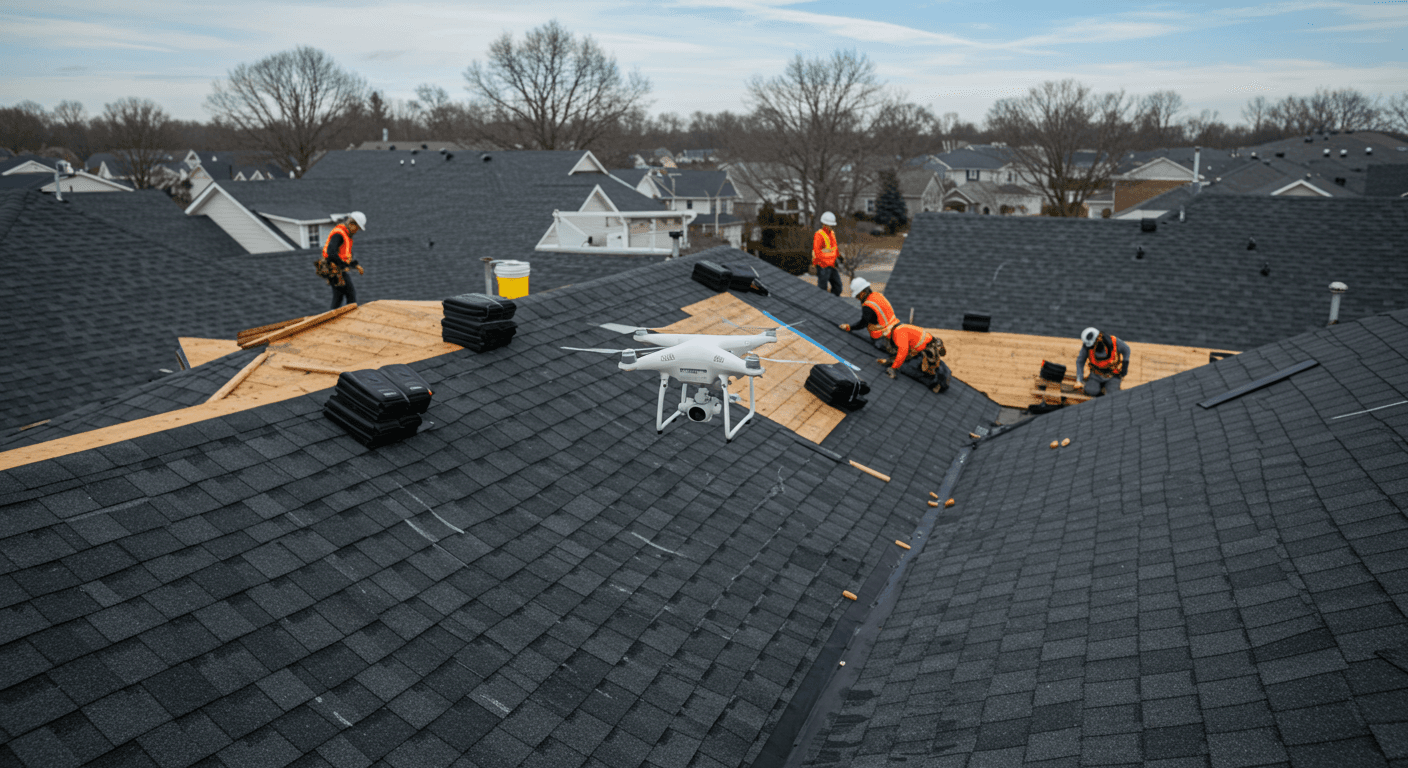
Finn's boot slid a few inches on a steep asphalt shingle while he danced between a handheld pitch gauge and a phone buzzing in his pocket. Roughly forty minutes into a supposedly quick Nashville-area storm sweep, chalk lines still waited and a tape hovered over a fiddly hip and valley jump. Trucks idling, diesel burning, ladders shifting, reps guessing. That jittery scene is expensive in a way spreadsheets rarely confess: manual inspections eat hours, widen measurement variance, and feed the slowdown between first knock and executable scope.
When owners share P&Ls in the mid single-digit millions, rooftop minutes almost always dominate the hidden labor column. Plenty of crews still treat climbs as obligatory theater, yet the daylight between handwritten dimensions and calibrated field data routinely separates a disciplined 32% gross margin from teams stuck near 24%. The shift away from tapes is not glamour chasing. It is basic arithmetic on rework, morale, supplements, and how fast reps can reopen kitchens with evidence instead of anecdotes.
Rough margin bleed from measurement drift, underestimated tear-off realities, and the extra decking or valley metal you order when guesses replace geometry.
The invisible bill behind a "free" inspection
Labor, fuel, and insurance still clock in whether you invoice for the visit or not.
Owners love to insist inspections cost nothing until you burden out a senior rep, amortize rigs, premium pressure from frequent climbs, and the soft cost of reschedule loops. Across shops I benchmark, fully loaded rooftop visits routinely land $194 to $247 before you sell a nail. Carry a twentieth close ratio and simple division says you sank more than $1,000 in motion just for one contracted kitchen table outcome.
Modern measurement stacks compress that funnel math. Buying a stitched aerial report and pairing it with a short verification walk trims the hard cost toward a manageable data pull plus roughly fifteen focused minutes onsite. Sellers stop moonlighting as surveyors and return to diagnosing homeowner goals. Industry partners such as the Western States Roofing Contractors Association keep publishing reminders that disciplined first-pass measurements underpin fewer supplement wars. Start clean, negotiate less from a deficit of facts.
Manual ladders vs calibrated field intelligence
| Cost driver | Tape-first workflow | Aerial-verified baseline |
|---|---|---|
| Typical on-roof dwell time | ~65 minutes chasing facets | ~14 minutes anchored to downloaded geometry |
| Starter waste cushion | ~10% fudge baked into composites | ~6 to 7% grounded in modeled cuts |
| Collateral safety exposure | Full climb cadence each visit | Climb selectively when anomalies demand eyes |
| Packaging homeowner proof | Hand sketches hours later | Branded overlays minutes after arriving |
Typical on-roof dwell time
Starter waste cushion
Collateral safety exposure
Packaging homeowner proof
Figures summarize mixed retail and CAT shops I audited in 2025; retrofit your own benchmarks before underwriting bonuses.
ROI levers you can invoice against
Shrink inspection labor by syncing aerial footprints before anyone clips a harness, then burn minutes on outliers only.
Retire phantom waste buffers once modeled waste tracks real cut paths instead of guesses from the ladder.
Reset loss-sensitive scores by cutting unnecessary climbs yet still documenting each slope aggressively.
Arm reps with dashboards that summarize damage so underwriting conversations cite pixels, not vibes.
Aerial maps and the 15-minute grounding pass
Let the airplane do the grunt work before you finalize facets on the ridge.
Aerial bundles from providers such as EagleView, Hover, or Roofr stopped being souvenirs for coastal franchises. Mid-market shops leaned on hand measurements for intimidating slopes until leadership forced every lead through a stitched plan first. Capacity jumped without new payroll: one Southeastern team moved from roughly 3.2 site visits per rep per day toward 5.8 once aerial math arrived before boots touched pavement. Efficiency alone is persuasive, yet the quieter win is starving over-order habits.
Manual packets often slap a blunt ten percent scrap allowance on composites. Imagery-backed takeoffs routinely prove that a straightforward gable can clear production at roughly 6.4% waste. On a forty-square bundle, bridging that gap claws back multiples of squares at roughly $115 all-in per square once labor and hauling are stacked. Multiply that realism across seasonal volume and the nickels resemble margin recovery instead of anecdotes.
Calibrate overlays to crews, not guesses
"Have production sign off quarterly on waste factors per crew lead. GIS lines get smarter faster when supers feed back tear-off quirks your model never guessed."
Accuracy without velocity still stalls. Tie those refreshed measurements into the same pipeline that pings reps when inbound demand spikes. Crews leaning on LeadZik's mobile alerting workflow can pair faster desk response with sharper inspection packets, letting them answer doors with numbers already aligned to what lives on the trusses.
Thermal cues, chipped granules, and defensible supplements
Let pixels flag what tired eyes skim past at dusk.
For storm-heavy books, debating hail verbally with adjusters drains everyone. Humans miss legitimate strikes when glare, exhaustion, or schedule compression stack up. Algorithms trained on stacked drone imagery can stress micro-fractures, heat signatures, or lifted seals that handheld photos barely capture. Unlocking roughly $2,100 in defensible supplementation on one overlooked slope can amortize subscriptions faster than debating whether to renew in January.
Transparency also wins kitchens. Showing a calibrated heat gradient beside macro views reframes Finn from fast talker into someone presenting traceable diagnostics. Conversation shifts toward repair sequencing and timelines instead of debating whether hail truly visited the block.
Manual-first habits do not merely slow estimating. They lengthen dry-in vulnerability, scramble crew sequencing, and keep people on elevation longer than underwriting teams expect. OSHA's plain-language roofing safety guidance bluntly reinforces how lethal falls remain for residential installers, which matters when insurers price every climb implicitly.
The low-tech trap owners rationalize
Stale measurements ripple into material shortages mid-production, extra supplier runs, tarp hours you never modeled, and legal exposure anytime someone mounts a slick plane without a forensic reason. Every eliminated climb trims both schedule risk and blunt injury exposure tied to hurried balance work.
Action Plan
A 30-day rollout that survives veteran egos
Hardware alone never saves margin. Adoption lives or dies when leadership threads training, KPI baselines, and CRM plumbing before anyone flexes over who owns the tech stack.
Days 1 to 7 · Baseline climbs, rework dollars, superseded orders, waste factors, average minutes per inspection, plus close deltas by rep.
Days 8 to 21 · Pilot one aerial partner, standardize UAV capture where supplements demand it, and route outputs straight into estimating templates CRM fields already consume.
Days 22 to 30 · Tie verified demand into the rollout so pricey intelligence never chases mismatched geography or homeowners who fade after the postcard wave.
High-precision inspections amplify waste when inbound demand is blurry. Operators who tighten territory fit alongside exclusive LeadZik demand finance better flights, fewer repeat visits, and cleaner scorecards tied to CAT expertise or retail overlays.
Margins compound quietly after the ladders slow down
Twenty saved minutes compound into neighbor conversations, dormant estimates, or production holds that never escalate.
Removing forty-five minutes from every inspection does not create vacation time. It reassigns reps toward neighbor introductions, underwriting follow-through, permitting nudges, and internal coaching. An Ohio retrofit team swapped tape-first policies for aerial-first approvals and shaved project-management drag roughly 17.4% within eleven months. They did not brute-force revenue. Friction vanished because materials matched modeled cuts and emergency distributor dashes eased.
Your software invoice is irrelevant if teams still pretend salespeople should double as crews. Stitch field intelligence into onboarding, dashboards, bonuses, even morning huddle reviews. Margin recovery nearing 22.8%, the headline statistic teams track here, emerges when disciplined data stops living in lone PDFs and instead steers forecasting, stocking, staffing, and the promises made at signing.