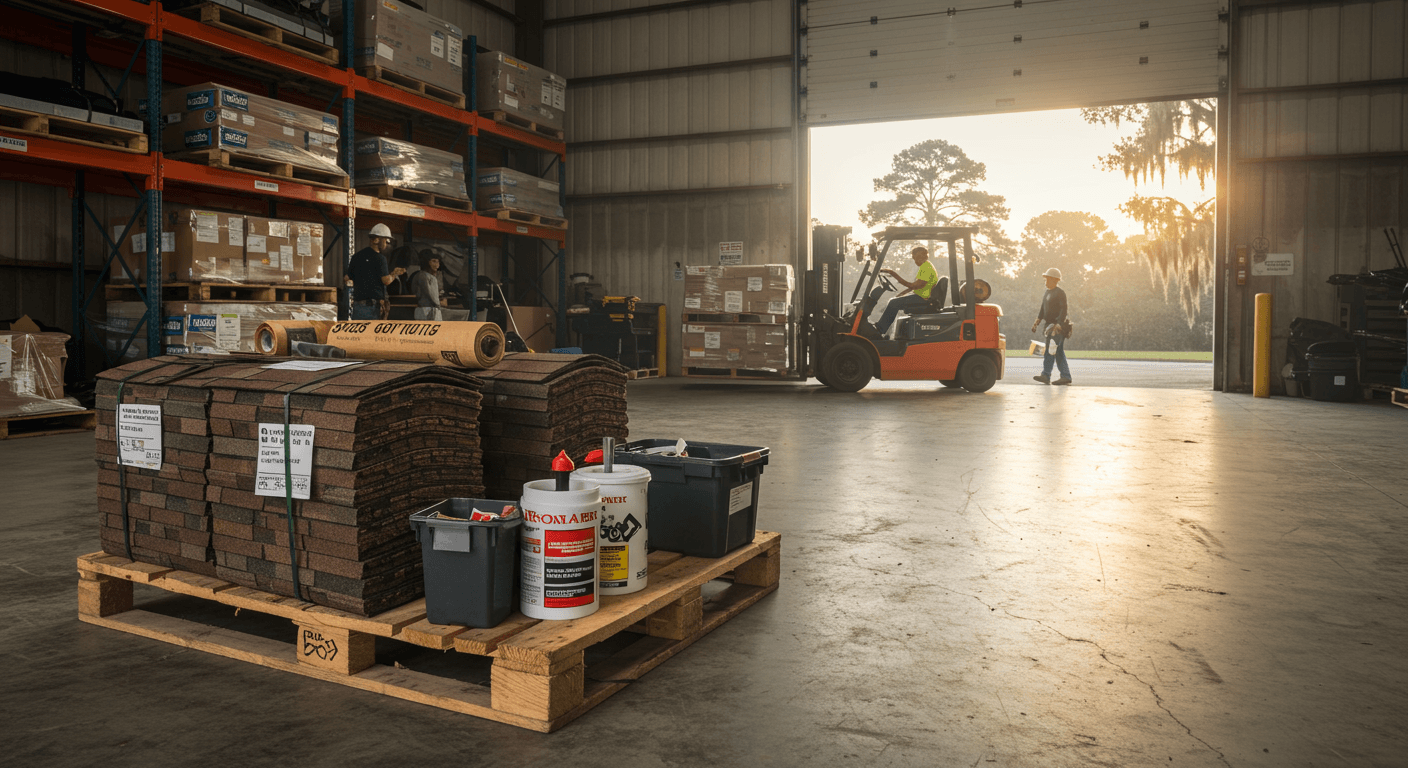
Conventional wisdom among the roofing outfits lining NW 13th Street suggests that inventory management is a "big box" problem, something for retail giants or manufacturers, not for a small-to-mid-sized contractor. Most owners I speak with in Alachua County believe that if the supplier drops the pallets at the job site on time, the system is working. They treat inventory as a pass-through expense, a line item that takes care of itself once the shingles hit the roof.
I spent three weeks last summer embedded with a local Gainesville contractor, whom I'll call Jaxon, to prove that this "pass-through" mentality was quietly gutting his net profit. Jaxon ran 12 crews out of a yard near the airport, and on paper, his revenue was soaring. However, his bank account didn't reflect the volume. We didn't find the missing money in his marketing spend or his labor rates. We found it in the "shingle graveyard" behind his warehouse and the $9,340 worth of unassigned "truck stock" that was disappearing every quarter.
The myth that inventory doesn't matter for roofers is the reason why so many shops hit a glass ceiling at the $3M mark. According to insights on strategic resource management from Harvard Business Review, small businesses often fail to scale because they lack the granular visibility into their physical assets that larger competitors weaponize. In Jaxon's case, fixing his inventory wasn't just about counting nails; it was about reclaiming 4.8% of his margin that was literally rotting in the Florida humidity.
At a Glance
Inventory leaks often hide in 'truck stock' and job-site overages that never return to the warehouse, costing Gainesville roofers thousands annually.
Transitioning from ad-hoc purchasing to a centralized kitting system can reduce material waste by 14% to 19% based on field observations.
Climate-specific storage in Gainesville is non-negotiable—humidity-damaged underlayment and warped drip edge are silent profit killers.
Real-time tracking tools allow owners to shift from reactive ordering to proactive asset management, stabilizing cash flow.
The Invisible Cost of the "Just-in-Time" Illusion
Jaxon prided himself on being lean. He didn't want a "cluttered" warehouse, so he relied almost exclusively on job-site deliveries. It sounds efficient until you see the math. We tracked six residential reroofs in the Haile Plantation area. On every single job, the supplier over-delivered by roughly 6%. This is standard practice to avoid "shortages," but Jaxon's crews weren't bringing the extra three bundles back. They were leaving them on the curb for the homeowner or tossing them into the dump trailer because "it's just three bundles."
At $38 per bundle, that's $114 per job. Multiply that by 420 jobs a year, and you've just thrown $47,880 into the landfill. When Jaxon saw that number, the color drained from his face. He realized his "lean" operation was actually a leaky bucket.
The problem wasn't just the shingles. It was the "small stuff"—the sealant, the flashing, the starter strips. Because there was no central inventory, crews were stopping at a supply house on Newberry Road twice a day to grab "one or two things." I calculated the "stop cost." Between the driver's hourly rate, the fuel, and the 45-minute delay in production, every "quick stop" cost Jaxon roughly $82. His crews were making 14 of these stops a week. That is over $1,100 a week in avoidable operational friction.
Auditing the "Truck Stock" Slush Fund
We started our transformation by doing a "blind audit" of Jaxon's three lead service trucks. We pulled them into the bay on a Friday afternoon and emptied everything onto the concrete. The results were staggering. We found $4,231 in miscellaneous materials across the three trucks.
- 14 unopened cans of high-grade sealant (half of them expired or dried out from the Gainesville heat)
- 216 linear feet of mismatched drip edge
- 4 rolls of synthetic underlayment that had been crushed under heavy tools
This was "zombie inventory." It was paid for, it was sitting in a truck, but because it wasn't in a system, Jaxon's office manager was still ordering those exact items for the next Monday's jobs. This lack of visibility is a classic operational bottleneck. In the seminal article The End of Solution Sales, Harvard Business Review argues that the most successful businesses are those that provide insights their customers (or in this case, owners) didn't even know they needed. The "insight" here was that Jaxon didn't need to buy more materials; he needed to find the ones he already owned.
Inventory Management Approaches
| Factor | Ad-Hoc (The Status Quo) | Centralized (The Lean Model) |
|---|---|---|
| Delivery Method | Job-site deliveries only | Warehouse 'kitting' for every job |
| Crew Supply | Crews 'self-supply' from local distributors | Strict truck stock par levels |
| Overages | Overages discarded or left on-site | Mandatory return-to-warehouse policy |
| Cost Tracking | Material costs tracked per invoice | Real-time asset tracking |
| Emergency Trips | High 'emergency' trip fees | Zero midday supply house runs |
Delivery Method
Crew Supply
Overages
Cost Tracking
Emergency Trips
Implementing the Gainesville "Kitting" System
To fix this, we implemented what I call the "Kitting Protocol." Instead of deliveries going to the job site and being managed by the crew lead, we started directing 80% of deliveries to Jaxon's warehouse.
Every evening, the warehouse manager (a role we repurposed from a part-time yard hand) would "kit" the jobs for the following day. This meant every nail, every roll of tape, and every flashing piece was counted and placed on a pallet. When the crew arrived at 6:30 AM, they hitched their trailer, loaded the kit, and left.
We also implemented a "Return to Base" (RTB) policy. If a crew came back with two bundles of shingles and a roll of underlayment, those items were scanned back into the "Used Stock" inventory. These were the first items used for the next small repair or "short" job. This simple shift reduced Jaxon's monthly material spend by 11.4% in the first 60 days.
Managing this level of detail requires a reliable flow of information. Just as we verified every nail coming back to the warehouse, successful contractors must verify every lead coming into their pipeline. Using a verified lead source ensures that the same level of precision you apply to your inventory is applied to your sales funnel.
The Florida Factor: Protecting the Profit from the Swamp
Gainesville's climate is brutal on roofing materials. During our audit, we found that nearly 12% of Jaxon's stored underlayment was unusable because it had been stored in a non-ventilated metal shed where temperatures hit 130 degrees. The adhesive backing on the ice and water shield had fused to the paper.
We reorganized the warehouse to prioritize "First-In, First-Out" (FIFO) and moved sensitive materials to a climate-controlled "cool zone" near the office. We also addressed the "Drip Edge Warp." In Florida, leaving aluminum drip edge in the back of a black pickup truck on a 95-degree afternoon is a recipe for disaster. By moving to the kitting system, materials stayed in the shade of the warehouse until the morning they were needed.
The 'Bucket Audit' Strategy
"Every Friday, have your warehouse lead inspect the 'scrap' buckets in your crew trucks. If you see more than 12 inches of usable flashing or more than 5 un-driven cap nails, your crews are over-ordering. This 5-minute check creates a culture of accountability that can save $300 per month per truck."
Measuring the ROI of Efficiency
By month six, the data was undeniable. Jaxon's "material waste" line item had dropped from 9.2% of total project costs to 3.7%.
But the real win was in labor efficiency. Because the crews weren't stopping at suppliers or "searching" for materials in the back of their trucks, they were finishing jobs an average of 72 minutes faster. In a market like Gainesville, where the afternoon thunderstorms usually roll in around 3:00 PM, that hour is the difference between a dry house and a frantic tarping session.
If you're wondering how these operational tweaks might apply to your specific shop size, checking out a detailed FAQ about scaling operations can provide more context on the infrastructure needed to support this growth.
Jaxon's material waste dropped from 9.2% to 3.7% of total project costs within six months
The Results: A Transformed Bottom Line
At the end of the first year of these changes, Jaxon's net profit had increased by $88,412. We didn't add a single new crew. We didn't raise his prices (though the market allowed for it). We simply stopped the bleeding.
He used that reclaimed capital to upgrade his fleet and invest in a more robust lead generation strategy. He realized that once his operations were "leak-proof," he could afford to spend more on high-quality acquisitions because he knew his margins were protected. For contractors looking to make a similar leap, a direct consultation on growth strategy can help identify where your specific "leaks" might be.
Recovered through inventory optimization without adding crews or raising prices
The Path Forward: Building Systems That Scale
Managing a roofing business in Gainesville is a game of inches. Between the humidity, the competitive labor market, and the rising cost of asphalt, you cannot afford to be "approximate" with your materials. Jaxon's story isn't an outlier; it's a roadmap. When you treat your shingles like cash—because they are—the rest of your operation starts to fall into place.
The kitting system we implemented wasn't revolutionary. It was systematic. Every material had a home. Every return had a process. Every dollar had accountability. That level of precision is what separates shops that hit $3M and stall from those that break through to $5M, $8M, and beyond.